

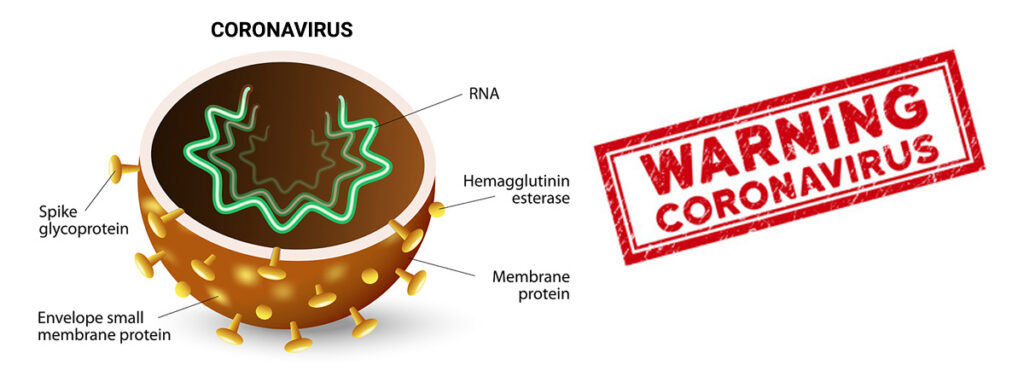
A December 2019 outbreak of a new virus that began in the city of Wuhan, China, has infected nearly 3000 people and killed 81 in China. The virus has already been confirmed in many other countries around the world as well.Â
Coronaviruses are common in many different species of animals, including camels, cattle, cats, and bats. Rarely, animal coronaviruses have also infected humans and then spread rapidly to other people. Whenever a new virus immerges or jumps from an animal to a human for the first time, it can spread rapidly because no one has developed immunity to it yet.
Most of the deaths from this new coronavirus in China, known as 2019 Novel Coronavirus (2019-nCoV), were in the central province of Hubei, which is the center of the outbreak. There have been 2,744 confirmed cases of the new coronavirus in China, of which 1,423 cases were in Hubei. The youngest confirmed case is a 9-month-old girl in Beijing. Fortunately, there have been no deaths yet, from the virus reported outside China.
The first infection with this new coronavirus in the United States, was reported on January 21, 2020. Two cases of the virus have been reported in California, one in Wasthington State, one in Illinois and one in Arizona, on ASU Campus. All 5 cases in the US, have occurred in native Chinese who had recently returned to the US from Wuhan, China.
Thailand and Hong Kong have each reported eight cases of infection; the United States, Taiwan, Australia and Macau have five each; Singapore, Japan, South Korea and Malaysia each have reported four; France has three; Canada and Vietnam have two; and Nepal, Cambodia and Germany all have one case each.
What are the Symptoms of Coronavirus
- Runny nose
- Headache
- Cough
- Sore throat
- Fever
- General feeling of being unwell
Basically, this virus appears like a Cold Virus. Those who have died from it are typically very old, very young, or immune compromised.Â
No Specific Medical Treatment Available
The CDC website states, “There is no specific antiviral treatment recommended for 2019-nCoV infection. People infected with 2019-nCoV should receive supportive care to help relieve symptoms. For severe cases, treatment should include care to support vital organ functions.â€
What Does Dr. Hansen’s Recommend?
NOTICE: Dr. Hansen does not claim that any of the following recommended Dietary Supplements are for the prevention, treatment or cure of COVID-19 or any other disease.
The most effective means of stopping any virus and avoiding the most harmful consequences of any virus is boosting your immune defense with Dietary Supplementation of Vitamins A, C and D. Although the CDC and Public Health Officials never seem to mention these simple remedies, they have been used with astounding benefits around the world in treating other highly infectious viruses.
The CDC, the American Academy of Pediatrics, as well as The World Health Organization recommend Vitamin A for all children exposed to or infected with Measles virus, regardless of their country of residence, to reduce the risk of pneumonia and complications with the immune system. Vitamin A is necessary for preserving the lining of the lungs and it plays a major role in immune enhancement.
Taking 200,000 IU of Vitamin A daily for two consecutive days has been shown to be associated with a 82% reduction in the risk of death from the measles virus in children under the age of two years (RR 0.18; 95% CI 0.03 to 0.61) and a 67% reduction in the risk of pneumonia-specific mortality (RR 0.33; 95% CI 0.08 to 0.92).
Source: Vitamin A for treating measles in children. Cochrane Database Syst Rev. 2005 Oct 19;(4):CD001479. American Academy of Pediatrics
Vitamin A should be administered once a day for 2 days at the following doses:
- 50,000 IU for infants aged <6 months
- 100,000 IU for infants aged 6–11 months
- 200,000 IU for children aged ≥12 months and all adults
An additional (third) age-specific dose of vitamin A should be given 2–4 weeks later to children with clinical signs and symptoms of vitamin A deficiency. (Source: CDC, updated 12/13/13)
“Vitamin A is not virus specific. It should provide the same or similar benefits for all similar viruses, including the coronavirus.â€
– Dr. Clark Hansen N.M.D.
Should You Wait for a Coronavirus Vaccine?
The deadly outbreak of a novel coronavirus has sparked a race among biotech companies, each claiming that its technology can quickly whip up a vaccine to quell a potential crisis. But history suggests the road ahead will be long, unpredictable, and expensive. During the 2003 SARS outbreak, it took American scientists 20 months to go from identifying the genetic code to the first phase of human trials.
Vitamin A Has Been Used to Boost Immune Defense Since Before Vaccines
According to the CDC, “Before the measles vaccination program started in 1963, about 3 to 4 million people got measles each year in the United States, of which 500,000 were reported. Among reported cases, 400 to 500 died, 48,000 were hospitalized, and 1,000 developed encephalitis (brain swelling) from measles.†Using the CDC statistics, the death rate due to Measles was estimated to be 500 deaths per 3 million cases. That is Case fatality rate of only 0.017%.  If the U.S. Health Department had instituted a “Mass Vitamin A Programs†instead of “Mass Vaccination Programs,†the death toll for Measles may have dropped by 82%, without the vaccine; from 500 children annually to only 90, which would have reduced the mortality rate to 0.003%. If this one simple program had been instituted instead of vaccinations, it would have protected 99.997% of the population from dying from Measles and allowed everyone to acquire permanent immunity, which moms could then pass on to their infants to protect them, and Measles today would still be a common, mild childhood infection that would occur only in children between the ages of 5-15 years. Using Vitamin A to boost immune resistance and reduce the risks of serious harm and death from other viruses, including the new Coronavirus, is just plain smart. This should be a top research priority for the NIH and arguably a wiser, more expedient, and less expensive goal than the risky, lengthy development of a vaccine for SARS-CoV-2, that could easily end up being neither safer nor effective.
Additional Immune Boosting Considerations
Elderberry has been found to be effective in boosting the immune defense against multiple strains of viruses.Â
Echinacea has a long history of immune benefits. In a meta-analysis of randomized controlled clinical trials, Echinacea was found to reduce the risk of recurrent respiratory tract infections by 58% (RR 0.420, 95% CI 0.222-0.796; P=0.005). The study concluded , “Evidence indicates that echinacea potently lowers the risk of recurrent respiratory infections and complications thereof. Immune modulatory, antiviral and anti-inflammatory effects might contribute to the observed clinical benefits, which appear strongest in susceptible individuals.” (Echinacea Reduces the Risk of Recurrent Respiratory Tract Infections and Complications: A Meta-Analysis of Randomized Controlled Trials. Adv Ther. 2015 Mar; 32 (3):187-200)
Astragalus and Andrographis have both been shown to boost immune defense by boosting Natural Killer (NK) Cell production and activation. NK Cells are the first innate immune cells to recognize and kill viruses by secreting toxic cytokines leading to viral cell death. They are the first responders to a viral infection and their job is to hold the line of defense until additional immune cells can be alerted and activated. (Evidence Supporting a Phased Immuno-Physiolgical Approach to COVID-19 From Prevention Through Recovery. Integrative Medicine, Vol 19, No. S, EPub ahead of print)Â
Â
Vitamin D3 Research
New research is showing that Vitamin D3, the active form of Vitamin D, stimulates the expression of a potent anti-microbial peptide, know as Cathelecidin. This peptide has been shown to destroy the cell walls of viruses causing them to break apart and disintegrate. Vitamin D also balances the immune response, preventing excessive inflammation that can lead to complications such as Pneumonia or Acute Respiratory Distress Syndrome (ARDS). Inflammation was the leading cause of deaths in the 1918 influenza pandemic and it appears that it may be the leading cause of deaths from SARS-CoV-2.Â
Flu viruses (including swine flu) and SARS Coronaviruses induce a massive inflammatory response that can overwhelm the body. In other words, it is uncontrolled over-production of pro-inflammatory cytokines. Vitamin D3 down-regulates the expression of pro-inflammatory cytokines such as tumor necrosis factor-alpha (TNF-a).
As people age, they often over-express these same destructive pro-inflammatory cytokines. The result is chronic low-level inflammation that damages aging arteries, joints, and neurons. By down-regulating excess pro-inflammatory cytokine production, vitamin D could save lives.
Antimicrobial peptides found in Vitamin D, known as Cathelecidins, are components of the immune system that protect against bacterial, fungal and viral infections. Secreted by immune cells throughout the body, Cathelecidins damage the outer lipid membrane of infectious agents (including influenza and coronaviruses), rending them vulnerable to eradication. A dose of 4000iu of Vitamin D3 has been shown to dramatically boost the production of Catehlecidins.Â
Summary
The truth is that in the worst epidemics of the world, only 20% of the population develops symptoms and only 1% or less of that group dies. Your best defense against a new viral infection is your own immune system. By boosting you immune resistance you are more likely to be among the 80-95% of the population who will escape most seasonal and new viral infections or who will recover quickly without complication.
Â