

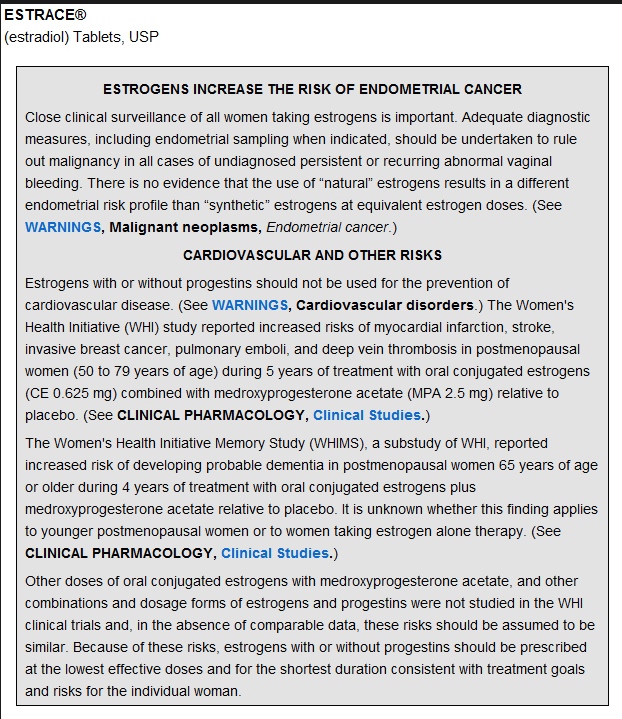
If you are taking ESTRACE®, or any other form of Estradiol, including Hormone Pellet Implants that include Estradiol, you need to read the WARNING label very carefully. Synthetic Hormone Replacement with any form of Estradiol or Estrone can cause serious life threatening risks, including heart attacks, strokes, blood clots, breast cancer, uterine cancer and dementia. Menopausal hormone imbalances now frequently begin when a woman is in her 40’s. Peri-Menopause and Menopausal symptoms are much more than a mere annoyance. Hormonal Imbalance can lead to Cancer, Heart Disease and Osteoporosis, but synthetic hormones, Birth Control Pills, Hysterectomy or Ablation treatments do not correct the Hormone Imbalance AND can cause more harm than good.
WARNING
This is the story of my patient Carla
When Carla first came to see me she was 51. She had had a Hysterectomy (removed her uterus but not her ovaries) at age 49 because she had developed heavy uterine bleeding every 2 weeks, which she described as gushing.
After her hysterectomy, her doctor put her on Estrace® but that seemed to only make her more irritable and gain more weight. She put on 30 lbs in less than 2 years. She didn’t want to stay on Estrace® because she had heard it was dangerous and her mother had died of breast cancer 8 years prior, so she finally decided to quit taking it and her hot flashes came back.
Carla had a long history of PMS symptoms, including moodiness, irritability, breast tenderness, as well as a major craving for sugar and salt. These are symptoms of high Estradiol and Estrone (the concentrated, cancer causing estrogens) and low Estriol and Progesterone (the natural anti-cancer hormones the body makes to counter the other two). Her menses had been regular until age 45, when it started getting shorter and shorter and heavier and heavier
By the time Carla came to see me she was suffering from 2-3 hot flashes per day and 2-3 times every night; she has absolutely ZERO sex drive; she had vaginal dryness and pain when she and her husband have intercourse and she felt “edgy, irritable, anxious and scattered or in a fog all the time.”
Carla also described suffering from hypoglycemia, which caused headaches and feeling week if she missed meals or ate too much sugar or didn’t eat enough fiber or didn’t eat every 3-4 hours.
When I see a new patient, I look at the whole picture of health and review the symptoms of every system of the body to gather all the interactive clues I can to figure out all the hormone imbalances involved and how they inter-relate. I have come to recognize Menopause as a Multiple Hormone Deficiency Syndrome.
Carla’s Symptoms:Â Hormone Deficiency
1)Â Â Hot Flashes: night sweats, sleeplessness:Â Estriol Deficiency
2)Â Â Brain Fog, Memory Loss:Â Estriol, Pregnenolone Deficiency
3)Â Â Anxiety, Moodiness, Irritability:Â Progesterone Deficiency
4) Â Weight Gain in Abdomen:Â DHEA, Testosterone Deficiency
5)Â Â Thinning skin, bones:Â Estriol, Growth Hormone Deficiency
6)Â Â Sagging Skin, Fatty arms:Â Growth Hormone Deficiency
7)Â Â Low Sex Drive:Â Testosterone Deficiency
8)  Fatigue, Can’t lose weight: Thyroid Deficiency
9)Â Â Hypoglycemia, Light headedness:Â Adrenal Cortisol Deficiency
What is causing more women to experience Menopause sooner?

What is the Conventional Treatment for Menopause?
- Ablation
- Hysterectomy
- Birth Control Pills
- Premarin
- Estrace® or other Estradiol containing Drugs
- Estradiol/Testosterone Pellet Implants
What Hormones do you need to Test and Supplement?
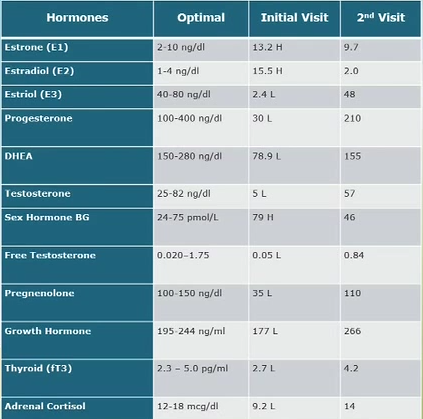
You should be testing all 12 of the hormones listed on Carla’s Lab Results below. These are the hormones I always recommend for all my patients in Peri-Menopause or Menopause. They are all inter-related and must be balanced in order for you to feel great and prevent Cancer, Heart Disease, Osteoporosis, Dementia, Brain Fog, Moodiness, Fatigue, waning sex drive, vaginal atrophy, thinning skin, fattening weight gain and the aches and pains of Menopause.
You will see in the Chart below that Carla’s Cancer Causing Estrogens were very high because she had been taking Estrace® and because her protective Estriol and Progesterone were low. Within only 3 months, Carla was able to restore the proper balance by following my simple, safe and effective daily routine of taking Sub-lingual (under the tongue hormones). She felt fantastic and reduced her risk of disease significantly.
Carla’s Lab Results
What is the best way to take Bio-Identical Hormones?
Sublingual Powder taken under the tongue is the best choice for both the short and the long term.
- High Absorption (90%+)
- Fast acting; goes directly into bloodstream
- Consistent dose: No excessive build-up; easy to change;
- No surgery: No Cancer Causing Chemicals
How is Carla doing now after Bio-Identical Hormone Therapy?
Within 2 weeks Carla’s hot flashes much better and within 6 weeks they were completely gone. She said she now has lots of energy, no more “brain fog,” feels less irritable, less scattered and more clear and sleeping better than she had in years.
At Carla’s 3 month follow-up, Carla reported feeling “awesome” for the first time in a very long time. Absolutely no more hot flashes or night sweats, her mood had mellowed out, her energy was back (in fact, she no longer needed her daily 1-1/2 cups of coffee – “Don’t need it at all,” she told me), she was sleeping really great, she had no more bloating and no more light headedness.
Carla was excited to find that she had lost 10 lbs on my “Vital Lifetime Diet” She said she loved our Vega Protein shakes and health menu plan because it made her feel satisfied and she wasn’t hungry at all. She said she loved getting back into exercising 30 minutes 4-5 days per week because she felt it really boosted her metabolism and her mood.
And, last but not least,Carla reported that her fingernails and hair were growing healthier and faster than ever before. She absolutely love the changes in herself. She felt like she had remade herself all over again to be the healthiest she had been in years and never wants to go back.
For more information about Dr. Hansen’s Bio-Identical Hormone Therapy, click here