

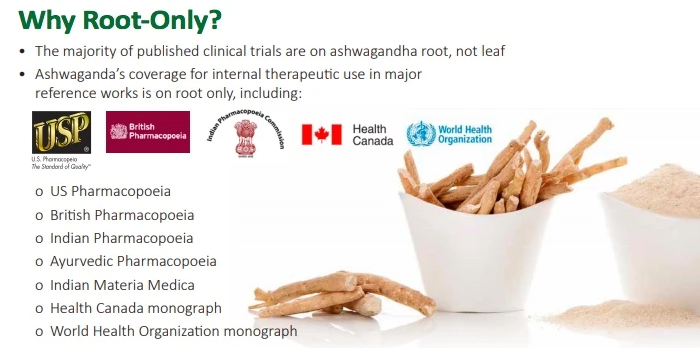
1. Dr. Hansen has 30+ years of clinical experience. He uses Ashwagandha Roots Only! Leaf components are never added.
There are some Ashwagandha manufacturers who make their extract using the plant’s leaves instead of just the roots. However, Dr. Hansen knows the scientific research and bases his formulations on published clinical trials and sources the highest quality, standardized extracts, proven in the clinical research to be safe and effective. For this reason he chooses only KSM-66® Ashwagandha, which contains the highest concentration of the clinically proven active ingredients from roots ONLY, with no addition of leaves. This is because the preponderance of pharmacologic and clinical research shows that the maximum clinical effectiveness is obtained from the more difficult to obtain and therefore more expensive root extracts.
Â
All of the standardized specifications for Ashwagandha from the Indian, the British and the U.S. Pharmacopeias are based exclusively on the root, never the leaves. There is a large number of studies documented in PubMed and conducted by universities and research hospitals, virtually all of which use root-only extracts and no leaves. While there are numerous human clinical studies using the root extract, virtually no clinical evidence for a root+leaf extract comes from published peer-reviewed research.
Â
Beware of cheaper Ashwagandha products and manufacturers who do not list the actual percentage of active ingredients contained in their product, or who claim their root+leaf product is superior because it weighs more. The truth is that 300mg of 5% Active Root ONLY Ashwagandha provides more of the key active ingredients than 1300mg of a 1% product. If the product does NOT list the percentage of the key active ingredient, it is likely to contain less than 1% and be ineffective. It may also include harmful leaf toxins. (To learn more, see: Avoid Withaferin A: leaf toxin)
2. Dr. Hansen uses only KSM-66® a full-spectrum Ashwagandha extract for optimal stress relief.
Botanicals are complex substances with many constituents in them. Nature combines multiple actively beneficial ingredients into foods and herbs. Research has shown that Ashwagandha contains multiple constituents that produce its stress and anxiety relieving benefits. This combination creates a synergy of the individual constituents that produces the clinical effects. For this reason, it is important to use an Ashwagandha product that contains the “full spectrum†of all of the natural constituents. This is known as a “full-spectrum†extract, which maintains the balance of the various constituents as it is in the original herb, without over-representing any one constituent, such as the Withanolides. Dr. Hansen uses KSM-66® Ashwagandha because it is the highest quality, full spectrum extract available. It is different from other chemical or alcoholic extracts because of its innovative extraction process that does not upset the delicate balance of various constituents found in natural ashwagandha root; rather, it retains and potentiates the synergism of the whole root. This superiority is demonstrated in its extensive clinical research and double-blind clinical trials.
3. Dr. Hansen uses the highest Standardized Active Ingredients (>5% Withanolides) confirmed by HPLC.
Â
When selecting an Ashwagandha product, make sure that the Withanolide content is neither too high nor too low. Having higher percentage of Withanolides (eg: 10%) is not desirable as it would upset the synergistic balance nature provides and produce suppression of the other important and protective constituents. Having too low percentage of Withanolides (eg: less than 2.5%) is also not desirable as it would require a higher dosage for consumption. KSM-66® Ashwagandha’s unique extraction process yields optimum percentage of Withanolides, retaining all of the important bioactives components of the plant, which are required for optimum safety and efficacy.
Â
The vast majority of manufacturers across the world estimate Withanolide content by gravimetric analysis, which does not provide accurate results. Unfortunately, gravimetric analysis often overestimates Withanolide content by a factor of 2.5 to 3! This is because gravimetry does not adequately discriminate between Withanolides and some other constituents, thereby bundling Withanolides with other compounds and over-assessing the extent of Withanolides. Furthermore, gravimetric analysis is not reliable.
Â
Dr. Hansen uses KSM-66® Ashwagandha because every batch is Standardized according to the most reliable HPLC methods of Withanolide assessment. This method is the most discriminating and accurate method of testing for active ingredient standards. KSM-66® Withanolide content as measured by HPLC is found to be >5% concentration in every batch.
4. Dr. Hansen’s uses only KSM-66® Ashwagnadha to eliminate the cyto-toxic Withaferin A that is high in products made with leaves.
Not all withanolides are beneficial. Withaferin A is one withanolide which is cytotoxic, as has been established in multiple scientific studies. Some Ashwagandha extracts have high levels of Withaferin A because the manufacturers use Ashwagandha leaves. Using leaves spikes up the overall withanolide content, but it also brings in the undesirable withanolide ‘Withaferin A’. KSM-66® Ashwagandha used by Dr. Hansen in Tranquil Clarity consists of negligible levels of Withaferin A, making it very safe for human consumption.
5. Dr. Hansen uses KSM-66® Ashwagandha exclusively because it has has been used in more clinical studies than any other brand.
KSM-66® Ashwagandha is used in more clinical trials investigating the safety and effectiveness of Ashwagandha than any other brand. It is the Ashwagandha extract with the most extensive set of research studies. Most other Ashwagandha manufacturers’ clinical trials are not published in PubMed accepted journals. KSM-66® Ashwagandha clinical trials are conducted by well-established physicians and scientists with strong publication record